

Key Highlights
- A bid is a small emotional invitation from one partner to connect, share, laugh, receive comfort, or feel noticed.
- Turning against a bid means responding with sarcasm, irritation, criticism, blame, contempt, or rejection instead of warmth.
- Small negative responses may look harmless in the moment, but repeated micro-rejections can slowly teach a partner to stop reaching out.
- Relationship research consistently connects partner responsiveness with emotional closeness, satisfaction, trust, and relationship stability.
- Sanpreet Singh helps couples understand these everyday patterns before they become emotional distance, resentment, or quiet withdrawal.
Why Small Moments Matter So Much in Love
A relationship rarely breaks only because of one dramatic argument. More often, love weakens quietly through small moments where one partner reaches out and the other responds with irritation, coldness, sarcasm, or emotional dismissal.
One partner says, “Look at this.”
The other says, “I’m busy.”
One partner says, “I had a hard day.”
The other says, “Everyone has hard days.”
One partner says, “Can we sit together for five minutes?”
The other says, “Why do you always need attention?”
Nothing “big” happened. No plates were thrown. No terrible words were said. But something emotional shifted.
A bid for connection is a small attempt to reach your partner. It may be a question, a joke, a touch, a sigh, a story, a shared memory, or even a random “come see this.” When your partner responds with warmth, they are turning toward you. When they ignore it, they are turning away. When they respond with criticism, contempt, rejection, or irritation, they are turning against you.
And turning against is where the real damage begins.
At Sanpreet Singh, this pattern is often explored with couples who still love each other but feel emotionally far apart. The wound is not always in the big fight. Sometimes, it is in the daily message: “You are not safe to approach.”
What Is a Bid for Connection in a Relationship?
A bid for connection is any small signal that says, “Please respond to me.” It may not sound emotional on the surface, but underneath it is a desire for attention, reassurance, humour, comfort, interest, or closeness.
A bid can sound like:
- “Listen to what happened today.”
- “Do you want tea?”
- “Come here for a second.”
- “I miss how we used to talk.”
- “Look at this funny video.”
- “Can you hold me?”
- “Do you think I handled that well?”
- “You seem far away today.”
Sometimes, a bid is not spoken at all. A partner may move closer on the sofa, make eye contact, send a meme, touch your arm, or sit quietly near you after a long day.
Tiny? Yes. Meaningless? Absolutely not.
If love had notifications, bids would be the unread messages in the emotional inbox. Ignore too many, and the system starts crashing. 😄
The Three Ways Partners Respond to Bids
Turning Toward
Turning toward means responding with interest, warmth, affection, humour, or care.
For example:
- “Tell me more.”
- “That sounds hard.”
- “I’m listening.”
- “Come sit with me.”
- “That’s funny.”
- “I’m tired, but I want to hear you properly.”
This response tells the partner, “You matter to me.”
Turning Away
Turning away means missing or ignoring the bid. It may happen because of stress, screens, fatigue, work pressure, or emotional overload.
It does not always come from cruelty, but repeated turning away can still hurt.
Turning Against
Turning against means responding harshly to the bid.
For example:
- “Why are you always so dramatic?”
- “Not this again.”
- “Can’t you see I’m busy?”
- “You need too much.”
- “You always ruin my mood.”
- “Here we go again.”
This response does not only reject the bid. It can make the person feel foolish for reaching out.
For couples already stuck in defensive patterns, improving the way both partners communicate becomes essential because the tone of response often matters as much as the content.
Why Turning Against Hurts More Than Couples Realise
Turning against is harmful because it attacks the moment of vulnerability.
When a partner makes a bid, they are taking a small emotional risk. They may be asking for comfort, attention, affection, or reassurance. If the response is harsh, the emotional lesson becomes clear: “Do not reach out like that again.”
Over time, the partner may stop sharing. They may stop asking. They may stop initiating touch, humour, stories, or repair. The relationship may become quiet, but not peaceful. It may look calm from the outside while feeling cold from within.
Research on partner responsiveness shows that feeling understood, validated, and cared for is strongly linked with relationship satisfaction and emotional connection. In simple words, people feel closer when their partner responds in a way that says, “I get you, and you matter.”
Turning against does the opposite. It says, “Your need is annoying.”
That message can bruise love deeply.
Turning Against vs Healthy Disagreement
Not every disagreement is turning against. Couples can disagree respectfully. They can set boundaries. They can say, “I need time,” or “I cannot talk right now,” without being cruel.
The problem is not saying no. The problem is making your partner feel small for asking.
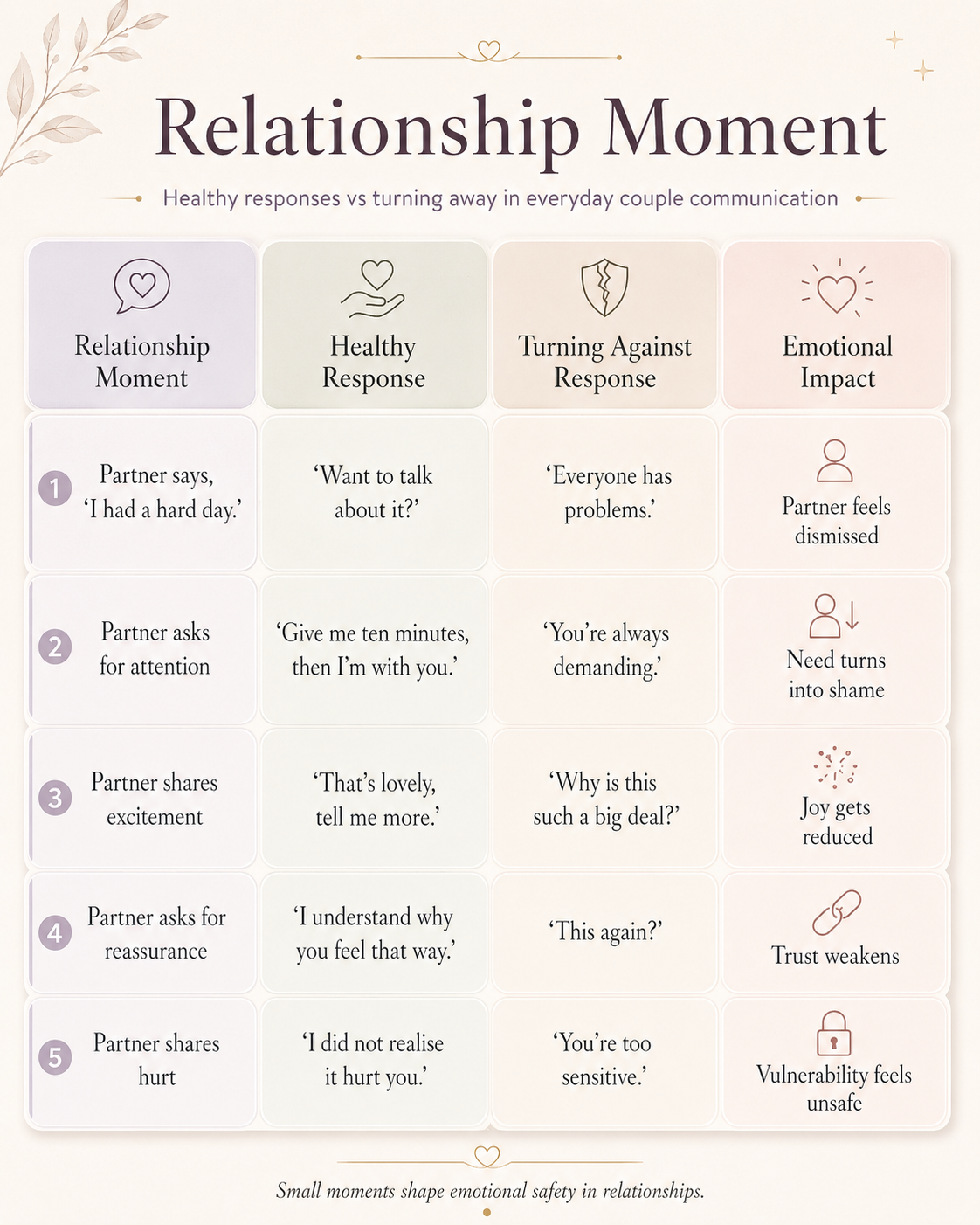
Healthy boundaries preserve respect. Turning against damages it.
How Small Rejections Become Big Emotional Distance
First, One Partner Tries Harder
When bids are rejected, the partner may initially try harder. They may repeat themselves, ask again, become emotional, or complain.
This can look like nagging, but often it is a desperate attempt to reconnect.
Then, They Begin to Withdraw
After enough rejection, the partner may stop trying. They may say, “Forget it.” They may share less. They may become quieter.
This is where emotional distance becomes dangerous. Silence may look like maturity, but sometimes it is self-protection.
For couples who feel alone even while still together, feeling lonely inside the relationship may point to a deeper pattern of missed or rejected bids.
Finally, Both Partners Misread Each Other
One partner thinks, “They never care.”
The other thinks, “They always complain.”
Now the relationship is no longer a home. It becomes a courtroom. Every sentence gets cross-examined. Every tone becomes evidence. Very exhausting, very not romantic.
Why People Turn Against Bids Even When They Love Their Partner
Many people turn against bids not because they do not love their partner, but because they are overwhelmed, defensive, tired, resentful, distracted, or emotionally guarded.
Stress Makes Small Requests Feel Big
When someone is exhausted, even a gentle bid may feel like another demand. A partner saying, “Can we talk?” may be heard as, “You are about to be blamed.”
Old Hurt Changes the Meaning of New Moments
If previous conversations ended badly, a simple emotional request may trigger defensiveness. The person reacts to the history, not the present moment.
Defensiveness Becomes a Shield
Some partners attack first because they are afraid of being criticised. But the shield becomes the weapon.
This is why conflict repair skills for couples matter. The goal is not to remove disagreement. The goal is to stop disagreement from becoming emotional injury.
Burnout Reduces Emotional Availability
When the mind is overloaded, love can start feeling like another responsibility. The person still cares, but their responses become sharper, colder, or more impatient.
Couples under constant pressure may need to understand how relationship burnout changes emotional reactions before blaming each other’s character.
What Turning Against Sounds Like in Daily Life
Turning against is not always loud. Sometimes it is subtle.
It can sound like:
- “You’re overthinking.”
- “Why do you make everything emotional?”
- “I was fine until you started.”
- “You always need something.”
- “Don’t start your drama.”
- “I’m not in the mood for this.”
- “You should know better.”
- “Can you not?”
It can also appear as eye-rolling, mocking, walking away harshly, laughing at vulnerability, or using silence as punishment.
One harsh response may not destroy a relationship. But repeated harsh responses create an emotional climate where reaching out begins to feel unsafe.
Why Turning Against Damages Trust
Trust is not only about loyalty. It is also about emotional approachability.
Can I come to you when I feel sad?
Can I share excitement without being mocked?
Can I ask for affection without being called needy?
Can I raise a concern without being attacked?
Can I be imperfect without being punished?
When the answer becomes no, intimacy begins to shrink.
The viral “bird test” became popular because it captured this simple truth: when someone points out something small, the real question is not about the bird; it is about whether the partner responds with interest. Experts also caution that one moment should not be treated as a full relationship diagnosis, but repeated patterns do matter.
In long-term relationships, emotional trust is built in tiny deposits. Turning against keeps making withdrawals.
For couples trying to recover safety after repeated hurt, rebuilding trust after emotional strain can help bring structure to what often feels confusing and painful.
The Negative Cycle Turning Against Creates
The pattern often looks like this:
- One partner makes a bid.
- The other responds harshly.
- The first partner feels rejected.
- They either protest or withdraw.
- The second partner becomes defensive.
- Both feel misunderstood.
- The next bid becomes harder.
This is how love becomes tense without one single “big” event.
A partner may stop saying, “Come sit with me.”
They may stop saying, “I missed you.”
They may stop saying, “I need you.”
Not because they no longer care, but because caring has started to feel unsafe.
For couples repeating the same painful loops, understanding why the same conflict mistakes return can help reveal the pattern beneath the argument.
How Couples Can Begin Repairing This Pattern
Pause Before Responding
Before replying, ask yourself: “Is this a complaint, or is this a bid for closeness?”
Many bids are poorly packaged because people are tired, scared, or hurt. Listen for the need beneath the words.
Replace Attack With Acknowledgement
Instead of saying, “You’re too much,” try:
“I hear you. I’m overwhelmed right now, but I don’t want to dismiss you.”
This keeps the door open.
Use Respectful Time Boundaries
You do not have to drop everything instantly. You can say:
“I want to listen properly. Can we talk after dinner?”
That is very different from rejection.
Repair Quickly After a Harsh Response
Repair does not require poetry. It requires ownership.
“I reacted badly. You were trying to connect, and I shut it down.”
Simple. Clear. Human.
Build a Culture of Small Responses
Look up. Smile back. Ask one more question. Touch their hand. Say, “I’m listening.” Reply to the meme. Laugh at the silly thing.
Small responses are not small to the nervous system. They tell your partner, “You can come closer.”
How Sanpreet Singh Helps Couples Notice the Pattern Earlier
Sanpreet Singh helps couples look beyond the surface argument and understand what is happening emotionally underneath.
A complaint may be a bid for reassurance.
Irritation may be a bid for help.
Anger may be covering hurt.
Withdrawal may be protection after repeated rejection.
The work is not about making couples perfect. It is about making the relationship safer, clearer, and more responsive.
For couples who need privacy while working through deeper relational patterns, private one-on-one relationship work can support more honest reflection. When trust has weakened through repeated emotional injury, structured rebuilding after trust has been affected can help couples move from blame to repair.
Where Couples Often Get Stuck
“I Was Just Joking”
Humour is healthy when both people feel safe. But when humour humiliates vulnerability, it becomes a weapon with a smile.
“They Always Ask at the Wrong Time”
Timing matters. But if every time is the wrong time, the issue may not be timing. It may be avoidance.
“I Don’t Know What They Want From Me”
Often, your partner does not want a perfect solution. They want attention, warmth, and emotional presence.
“If I Respond, It Will Become a Big Conversation”
Turning toward does not always mean a two-hour discussion. Sometimes it means saying, “I care. Let’s talk properly in a bit.”
For couples who keep missing each other emotionally, how emotional withdrawal starts in stable marriages can help name the pattern before it hardens.
Signs Turning Against Has Become a Relationship Pattern
You may be dealing with this pattern if:
- One partner hesitates before sharing feelings.
- Small requests trigger big irritation.
- Jokes often carry hidden criticism.
- One partner frequently says, “Forget it.”
- Conversations become defensive very quickly.
- Affection reduces after repeated rejection.
- Emotional repair feels awkward or delayed.
- One partner feels safer staying silent.
- Both partners feel misunderstood, even when they are trying.
This is often how good people end up hurting each other. Not always through cruelty, but through repeated emotional misattunement. Why good people still hurt each other is often less about bad character and more about unexamined patterns.
Final Thoughts
Relationships are not only shaped by big betrayals, dramatic arguments, or major decisions. They are shaped by the small moments where one partner reaches out and the other decides how to respond.
Turning against a bid teaches the heart to hide.
Turning toward teaches the heart that it is safe to come closer.
Most couples do not need a perfect response every time. That is unrealistic. Real life has stress, deadlines, tiredness, family pressure, and low-battery patience. But couples do need enough warmth, repair, and emotional responsiveness for the relationship to feel like a safe place again.
Love does not only ask, “Will you stay?”
It also asks, quietly and daily, “Will you respond when I reach for you?”
FAQs
What is a bid for connection?
A bid is any small attempt to get attention, affection, comfort, interest, or emotional response from your partner.
What does turning against a bid mean?
It means responding to a partner’s attempt to connect with sarcasm, criticism, irritation, rejection, blame, or contempt.
Why is turning against so harmful?
It makes emotional vulnerability feel unsafe and teaches the partner to stop reaching out over time.
Is ignoring a bid the same as turning against it?
No, ignoring is turning away; turning against is more actively harsh, rejecting, or negative.
Can one harsh response damage a relationship?
One moment may not, but repeated harsh responses can create emotional distance and resentment.
Why do partners turn against bids?
Stress, defensiveness, old hurt, fatigue, distraction, or resentment can make bids feel like pressure.
How can couples repair after turning against a bid?
They can acknowledge the hurt, apologise clearly, and respond with more warmth the next time.
Can small responses really improve a relationship?
Yes, small consistent responses build emotional safety, trust, and closeness over time.
What if my partner’s bids feel overwhelming?
Set a respectful boundary without attacking, and return to the conversation when you are emotionally available.
How can Sanpreet Singh help with this pattern?
Sanpreet Singh helps couples understand repeated emotional patterns, reduce reactivity, and rebuild safer communication.