

Key Highlights
- Most “petty fights” are not really about the towel, the tone, or the “seen” message. They are about what it signals: respect, safety, fairness, attention, or trust.
- Research consistently links frequent small conflicts to stress spillover, demand-withdraw cycles, attachment triggers, sleep loss, tech distraction, and unequal mental load.
- The goal is not “no conflict.” It is better repair: soft start-ups, validation, time-outs when flooded, and clear need-plus-request language.
- If the same small fight keeps repeating like a bad app update, it is not a willpower issue. It is a pattern issue.
Small recurring arguments often look minor from the outside, but inside a relationship they can slowly reshape connection, safety, and trust. At sanpreetsingh.com, Sanpreet Singh works with couples facing repeated conflict patterns, especially when those patterns start affecting emotional closeness, communication, and day-to-day stability. For many couples, this is where couple’s therapy, relationship counselling, or more focused conflict resolution for couples starts becoming relevant.
The “Small Things” That Start Big Fights
It is always something tiny on paper:
- A towel on the bed
- “You left me on read” or “you replied cold”
- The sigh, the eye-roll, the tone
- Who ordered food, who did not, who “forgot”
- One joke that did not land as a joke
- A reminder that sounded like a lecture
- A comment in front of family that hit differently
And then suddenly, boom — a 40-minute argument. Or the worse sequel: silence, passive aggression, and that strange feeling of sharing a house without sharing a heart.
Here is the core truth relationship science keeps repeating: couples often argue less about the topic and more about the meaning and the process. When repair is weak, even small moments turn into emotional injuries.
And over time, repeated “small” fights can quietly snowball into emotional distance in marriage that does not begin with one dramatic rupture, but with a growing loss of emotional safety. In many relationships, the visible argument is only the surface layer of deeper communication problems in relationship that have been building for a while.
Why This Happens: Small Fights Are Big Messages in Tiny Packaging
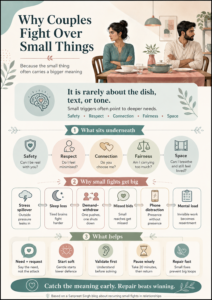
Most tiny triggers become explosive when they hit one of these five core needs:
1. Safety
Emotional safety, not just “no shouting.”
“Can I be myself with you without getting mocked, punished, ignored, or dismissed?”
2. Respect
“Do you take me seriously, or do I feel minimized?”
3. Connection
“Do you choose me in everyday moments, or only when it is convenient?”
4. Fairness
“Are we carrying life together, or am I carrying you too?”
5. Autonomy
“Do I get space to breathe and still feel loved?”
So a fight that starts as “Why didn’t you text?” often really means:
“I didn’t feel chosen. And that scared me.”
A fight that starts as “Why is the house always messy?” often really means:
“I’m overwhelmed and alone in this.”
A fight that starts as “Why are you talking to me like that?” often really means:
“I do not feel emotionally safe with you right now.”
Most couples do not say the need directly. They fire it out as criticism, sarcasm, or defensiveness. Then the nervous systems take over.
The Research-Backed Reasons Couples Fight Over Small Things
1. Stress Spillover: Life Pressure Leaks Into Love
One of the most consistent findings across relationship research is spillover: stress from outside the relationship — work overload, financial pressure, family duties, health issues — bleeds into the relationship and often lands on the closest person.
When stress is high:
- Patience drops
- Threat-sensitivity rises
- Emotion regulation gets worse
- Small irritations feel like one more thing you cannot handle
A very real example:
You are already maxed out from work, deadlines, messages, and low sleep. Then your partner says, “Did you do that thing?” with a tone. Your brain does not hear a question. It hears: I am failing. I am alone. I am being judged.
Micro-practice:
Before trying to solve the small issue, ask:
“Are we actually fighting about the thing, or are we fighting while stressed and depleted?”
If it is depletion, the first fix is regulation, not debate.
2. Sleep Loss: Your Brain Cannot Be Kind on 2% Battery
Sleep deprivation does not just make people cranky. It changes conflict dynamics.
So yes, that midnight fight about the one dish may genuinely be a sleep-deprivation fight wearing a dish costume.
Micro-practice:
If it is late, you are tired, and emotions are rising, call a pause and reschedule:
“I care about this, but my brain is not being a nice place right now. Can we talk tomorrow at 7?”
3. Attachment Triggers and the Demand-Withdraw Loop
Conflict often activates deeper fears: abandonment, rejection, loss of control, or not being enough.
A common pattern:
- One partner pursues: “Talk to me. Explain. Fix this.”
- The other withdraws: “Not now. Too much. I’m done.”
- Pursuit intensifies, withdrawal increases, and both feel unsafe
Nobody has to be the villain here. Often, it is just two self-protection strategies crashing into each other.
Micro-practice:
“When I’m scared, I chase. When you’re scared, you shut down. Can we slow down and try this differently?”
4. Missed Bids for Connection
A bid is a small attempt to connect:
- “Look at this.”
- “Guess what happened.”
- “Can you sit with me?”
- A meme, a story, or a tiny complaint that is secretly a request for closeness
Here is where petty fights often begin: when bids are repeatedly missed, people stop asking nicely and start asking angrily.
This is also where intimacy loss in relationship often begins — not with one dramatic collapse, but with thousands of tiny moments of “I reached for you, and you were not really there.”
Micro-practice:
Treat bids like notifications you actually want to keep.
Even a ten-second response counts: eye contact and “tell me.”
5. Tech Distraction: Presence Without Presence
Phones create a whole new conflict category.
A person can be right there and still not feel present.
Examples:
- You are talking, they are scrolling
- You are sharing something emotional, they are half-listening
- They reply instantly to everyone else, but you get “seen”
Micro-practice:
Try a simple agreement:
“When we are eating, in bed, or talking about something important, phones go face down.”
This is not control. It is a signal of priority.
6. Mental Load and Cognitive Labor
Many “small fights” are really protests against invisible work: planning, remembering, anticipating, managing, coordinating.
So the dish is not just a dish.
It becomes a symbol for:
- “I cannot relax because I am carrying the system.”
- “I do not trust you to notice what needs doing.”
- “I feel like the manager of our life, not your partner.”
Micro-practice:
Replace “I’ll help” with “I own this.”
Ownership reduces resentment because it reduces monitoring.
7. Negative Sentiment Override
This is when the relationship lens turns dark, and neutral behaviour starts feeling negative.
So:
- “Can we talk later?” becomes “You are avoiding me.”
- “I’m tired” becomes “You do not want me.”
- “You forgot” becomes “You do not care.”
Micro-practice:
Build positive deposits daily. Not as fluff, but as infrastructure.
Small positive interactions help protect couples during conflict.
8. Cultural Scripts and Family Systems
In many Indian contexts, small fights carry extra weight because they are not only between two people. They are happening inside a larger family ecosystem.
That is why living with parents after marriage in India is not just a lifestyle situation. It can become a daily boundary negotiation around:
- Privacy
- Loyalty
- Decision-making power
- Respect norms and gender expectations
- Emotional buffering inside the family system
Micro-practice:
Ask each other:
“What value is this touching for you — respect, privacy, loyalty, or autonomy?”
Values clarity reduces pointless looping.
Why Small Arguments Escalate So Fast
Most couples do not notice that conflict usually escalates in a predictable chain.
The Escalation Ladder
- Trigger
- Meaning
- Emotion
- Protection
- The partner reacts to the protection, not the emotion
- The loop repeats
- Repair fails and resentment gets stored
Your job is not to win.
Your job is to catch it earlier on the ladder.
The “Underneath” Statements Couples Rarely Say Out Loud
Here is a simple translation table you can actually use in the middle of conflict:
What gets said | What it often means | A cleaner request |
“Why didn’t you text?” | “I felt unimportant and got scared.” | “Can you send a quick ‘busy, talk later’?” |
“You never help.” | “I’m overwhelmed and alone.” | “Can you fully own X this week?” |
“Stop talking like that.” | “I don’t feel safe with that tone.” | “Can we restart softer?” |
“Whatever.” | “I’m flooded and shutting down.” | “I need 20 minutes, then I’ll come back.” |
When couples can translate meaning into needs, fights shrink.
When they cannot, many start slipping into communication problems in relationship, where everything becomes logistics and nothing feels emotionally held. In some marriages, that repeated friction also begins to resemble feeling lonely in the relationship long before either partner calls it that.
How to Break the Pattern
1. Use the Need + Request Formula
Replace criticism with clarity.
Use:
“When X happens, I feel Y, because I need Z. Could we do A?”
Examples:
- “When I don’t hear from you for hours, I feel anxious because I need reassurance. Could you send ‘busy, talk later’?”
- “When the house is chaotic, I feel stressed because I need order to relax. Can we do a 10-minute reset after dinner?”
This language does not erase emotion. It gives emotion direction.
2. Start Soft if You Want the Ending Soft
Harsh starts invite defensiveness. Gentle starts reduce escalation.
Hard start: “You never listen.”
Soft start: “I’m feeling unheard. Can I have two minutes of your attention?”
Soft does not mean weak. Soft means effective.
3. Validate First, Solve Second
Validation is not agreement. It is emotional recognition.
Try:
- “That makes sense.”
- “I get why that hurt.”
- “I see the impact, even if I meant something else.”
This is one of the fastest ways to de-escalate because it stops your partner from having to prove their feelings.
4. Take a Time-Out When Flooded
When people are physiologically flooded, reasoning collapses.
Set a rule together:
- A pause word: “Reset” or “Pause”
- A 20-minute break
- A return time: “We’ll talk at 8:30”
Non-negotiable:
No punishment silence. A break is for regulation, not revenge.
5. Use Repair Attempts More Often
A repair attempt is any small action meant to reduce negativity and stop escalation.
Repairs can be tiny:
- “Can we restart?”
- “I’m on your side.”
- “That came out wrong.”
- “I love you. I’m just stressed.”
If your relationship had a save button, repairs would be it.
6. Make Invisible Work Visible
Do a weekly 20-minute home-operations check-in:
- What is coming this week?
- Who owns what?
- What feels heavy?
- What needs adjusting?
Not romantic. Extremely stabilising.
7. Build Dyadic Coping
This simply means handling stress as “us versus the problem.”
Try this line when stress spikes:
“I’m not mad at you. I’m stressed. Can we team up?”
That one sentence can stop a week of pointless fighting.
When the Same Small Fights Keep Repeating
If your fights keep repeating, it often means:
- A core need is chronically unmet
- Roles and routines are unclear
- An emotional injury was never properly repaired
- A demand-withdraw loop has become the default
- Trust has tiny cracks that were never addressed
This is often how trust issues in relationship begin to form — not always through one huge betrayal, but through unresolved hurts, broken micro-promises, and repeated moments of “I cannot rely on you emotionally.”
At this stage, structured support helps because couples inside the loop cannot always see the loop clearly.
This is also where working with a relationship repair professional like Sanpreet Singh can help — not to take sides, but to:
- Map the repeat cycle
- Translate hidden needs
- Build repair rituals
- Set boundaries, especially with family systems
- Rebuild emotional safety and trust
- Practice communication skills that still work under real stress
Because most couples do not lack information. They lack rehearsal under pressure.
For some couples, this kind of structured support may look like couple’s therapy, conflict resolution for couples, or relationship counselling when the goal is to break the loop instead of replaying it.
A Simple Small-Fight Decoder
Next time a small fight starts, do this 60-second check:
Step 1. What happened?
Just the facts. No mind-reading.
Step 2. What did I make it mean?
“My brain told a story. What story?”
Step 3. What did I feel?
Hurt? Fear? Embarrassment? Overwhelm?
Step 4. What do I need?
Reassurance? Respect? Help? Rest? Closeness?
Step 5. What is my request?
One clear, doable action. Not a character verdict.
This turns chaos into clarity, and clarity is basically relationship magnesium.
FAQs
Is it normal to fight over small things?
Yes, especially during stress, sleep loss, life transitions, or when needs are not being communicated clearly.
Why do tiny issues escalate so fast?
Because they often trigger deeper meanings such as respect, safety, and fairness, along with protective responses like defensiveness or withdrawal.
Are frequent small fights a red flag?
Not automatically. The bigger red flags are contempt, threats, stonewalling without repair, or feeling emotionally unsafe.
What is the fastest de-escalation move?
Validate first, then problem-solve. People calm down faster when they feel understood.
Why do we keep fighting about chores?
Chores often represent mental load and perceived inequality, not just mess.
Does phone use really hurt relationships?
Consistent phone distraction can quietly reduce connection, responsiveness, and relationship satisfaction.
What if one partner shuts down during conflict?
That can be flooding or withdrawal. Use time-outs with a return time to prevent escalation.
How do we stop repeating the same fights?
Treat it as a pattern. Improve start-up, validation, repair, and systems for sharing stress and workload.
How does living with parents affect couple conflict?
It can intensify tensions around boundaries, loyalty, privacy, and autonomy, especially when involvement is high.
When should we seek professional help?
If conflict feels repetitive, escalating, emotionally unsafe, or creates ongoing distance, structured support can help break the loop.
Closing
Small fights are not proof your relationship is doomed.
They are usually proof your relationship needs maintenance — like a high-performance car that is still a high-performance car, just overdue for service.
Pick one shift this week:
- Soft start-up
- Need plus request
- Time-out with a return time
- Daily bids for connection
- Weekly home-operations check-in
- Repair attempts after conflict
Do that consistently, and the small things start feeling small again. Honestly, that is the goal.
If repeated conflict is starting to reshape the whole relationship, it can also help to understand how counselling sessions work, who tends to benefit most from support, and whether a relationship reset program or communication problems in relationship program is the more relevant next step.