

Marriage is often spoken about in extremes—happy or unhappy, stable or broken, love or loss.
But real long-term partnership rarely lives at the extremes.
Many marriages sit in a quieter middle space: the relationship still functions, the household still runs, and yet there is a persistent undercurrent of emotional disconnection that is hard to name. No dramatic fights. No daily warfare. No single “moment” you can point to.
And still, something feels undeniably different.
Two people continue sharing routines, responsibilities, and physical proximity, yet the felt sense of closeness gradually weakens. Conversations start sounding like information exchange, not emotional connection. Affection becomes less instinctive. Vulnerability feels heavier, rarer, or “not worth it.”
Nothing catastrophic happened.
But something subtle changed.
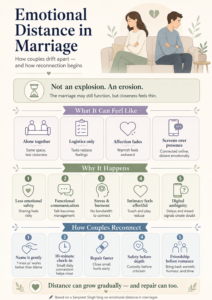
This is the often-misunderstood reality of emotional distance in marriage: not an explosion—an erosion.
Sanpreet Singh, a relationship repair professional who helps couples navigate complex emotional patterns, describes it with a clarity that resonates for many:
“Emotional distance is not a sudden rupture.
It is usually the accumulation of unattended moments, unmet emotional needs, and unspoken experiences.”
If you want structured support to rebuild closeness without blame or drama, you can explore Sanpreet Singh’s work at sanpreetsingh.com—especially if you have been feeling stuck in a quiet drift you cannot reverse on your own. For many couples, this is where marriage counselling or relationship counselling starts becoming relevant, especially when the deeper need is rebuilding emotional connection rather than simply managing surface tension.
What Emotional Distance in Marriage Really Means
Emotional distance in marriage is frequently trivialised or mislabelled. It is not simply:
- “Talking less”
- “Being busy”
- “Routine settling in”
- “Needing space”
At its core, emotional distance in marriage is a shift in emotional accessibility between partners.
It is the experience of feeling:
- Less emotionally seen
- Less emotionally understood
- Less emotionally safe
- Less emotionally connected
It often shows up as one persistent sensation:
Being together, yet not truly with each other.
And that is why emotionally distant marriages can still look stable from the outside:
- Bills are paid
- Children are cared for
- Social functions are attended
- Responsibilities are fulfilled
From the outside, the marriage appears intact.
Inside, partners may feel:
- Lonely despite companionship
- Disconnected despite communication
- Emotionally unsupported despite cooperation
What Emotional Distance in Marriage Looks Like Now
A modern marriage can drift without anyone leaving, because emotional presence is quietly replaced by noise, speed, and constant partial attention.
In everyday life, emotional distance in marriage can look like:
- Sitting in the same room, each on a screen—comfortably distracted, quietly disconnected
- Replies that are technically polite, but emotionally empty
- A partner sharing a concern and getting a distracted “hmm” or “okay”
- Conversations becoming entirely about tasks, timelines, and logistics
- The feeling that you have to schedule emotional closeness like a calendar event
And yes, digital behaviour often becomes part of the distance:
- “Seen” but no reply
- Delayed responses that trigger overthinking
- Vanishing mode or disappearing messages creating confusion
- Online presence without emotional availability
Sometimes these are harmless habits. Sometimes they quietly erode trust. In those moments, if you have turned on you disappearing messages, you partner starts to question you. As digital ambiguity does not always mean betrayal, but it often increases emotional uncertainty.
The Silent Drift: How Emotional Distance in Marriage Develops
Unlike dramatic marital crises, emotional distance in marriage rarely announces itself. There is usually no single defining incident that marks the beginning.
Instead, distance enters through small incremental shifts:
- A postponed conversation here
- A distracted response there
- An emotional disclosure brushed aside
- A bid for connection unnoticed
- A minor hurt left unresolved
Each moment alone seems insignificant. Together, they reshape the emotional climate of the marriage.
Over time:
- Emotional check-ins become less frequent
- Conversations lose depth
- Vulnerability feels riskier
- Affection becomes less spontaneous
- Silence becomes easier than honesty
Partners gradually recalibrate:
- Sharing less because it feels simpler
- Asking less because it feels futile
- Expressing less because it feels unsafe
The marriage does not collapse.
It adapts to emotional minimalism.
This is also why small conflicts matter more than couples realise. Many relationships do not break because of one big issue, but because repeated small irritations become permanent background tension. That is often why couples fight over small things: tiny conflicts are frequently where emotional safety begins to erode.
The Gradual Normalisation of Disconnection
One psychologically fascinating aspect of emotional distance in marriage is how easily it becomes woven into everyday life.
Humans adapt. What initially feels uncomfortable slowly becomes familiar. Silence that once felt heavy starts feeling normal. Reduced intimacy starts feeling like routine. Emotional gaps lose urgency.
This normalisation rarely happens consciously. Instead, partners begin to tell themselves:
- “This is just how marriage evolves.”
- “Not every phase can feel close.”
- “We’re functioning, so we’re fine.”
Adaptation protects stability, but it can also mask deterioration. The relationship stops demanding repair because it no longer feels like an emergency.
And yet beneath that quiet acceptance, emotional deprivation keeps accumulating.
Emotional Distance in Marriage and the Illusion of Compatibility
Emotional distance in marriage can sometimes create a deceptive sense of harmony.
With fewer emotionally charged conversations:
- Conflicts may reduce
- Disagreements may soften
- Tension may appear lower
But this peace is often not the result of deeper understanding. It can be the result of reduced emotional engagement.
Partners stop raising vulnerable concerns. Stop initiating difficult conversations. Stop expressing unmet needs. What looks like compatibility may actually be mutual withdrawal.
The absence of friction gets mistaken for relational health, even as intimacy declines.
The Internal Dialogue Couples Rarely Share
Inside emotionally distant marriages, partners often carry rich private dialogues they do not speak out loud:
- “Why do I feel alone when I’m not alone?”
- “Shouldn’t we feel closer than this?”
- “Is something wrong with us?”
- “Is this reversible?”
These questions stay private because of fear:
- Fear of sounding critical
- Fear of triggering defensiveness
- Fear of creating instability
- Fear of confronting painful truths
So emotional distance in marriage becomes reinforced not only by behaviour, but by mutual hesitation.
Both partners sense the shift.
Both stay silent about it.
How Emotional Distance in Marriage Changes Your Identity Inside the Marriage
Prolonged emotional disconnection does not only affect the relationship. It affects how you experience yourself inside it.
Partners may begin to feel:
- Less expressive
- Less spontaneous
- Less psychologically visible
When emotional responsiveness drops, people share less—not because their inner world disappeared, but because it no longer feels received.
Over time, a vague but unsettling experience appears:
“Parts of me feel absent here.”
This is not just relational discomfort. It touches deeper needs for recognition, validation, and emotional resonance.
Why Emotional Distance in Marriage Happens: The Most Common Drivers
1. Emotional safety slowly reduces
When honesty meets dismissal, sarcasm, judgment, or shutdown, people learn that it feels safer to share less.
This is often the beginning of Loss of Emotional Safety in Relationships, because emotional distance frequently starts with the feeling that it is no longer safe to be fully real.
2. Communication becomes functional instead of connective
This is extremely common in dual-career marriages: the relationship becomes a project management meeting.
You talk all day, yet nothing meaningful is exchanged.
This is often the reality inside Communication Breakdown in Working Couples, where high-functioning marriages still lose emotional closeness.
3. Stress and burnout reduce relational capacity
When both nervous systems are overloaded, couples stop repairing. Not because they do not care, but because they do not have the bandwidth.
Burnout makes emotional presence feel expensive. And when presence disappears, distance grows.
This is also why Relationship Burnout keep on happening in High-Pressure City Life matters so much. Love may still exist, while connection quietly weakens under chronic depletion.
4. Intimacy becomes risky, awkward, or too effortful
Intimacy rarely dies first. Safety and friendship often weaken first, and then desire becomes complicated.
Touch reduces. Play reduces. Romance begins to feel like work.
Many urban couples in this position are really dealing with Intimacy Loss Among themselves, where intimacy decline reflects emotional disconnection rather than only low desire. In many marriages, rebuilding emotional connection has to come before desire can feel natural again.
5. Digital ambiguity increases emotional uncertainty
Modern couples often get triggered by micro-signals:
- Delayed replies
- Read receipts without response
- “Online but unavailable” patterns
- Disappearing messages that confuse boundaries
Even when nothing bad is happening, ambiguity increases stress. That is why disappearing messages are a red flag when discussing modern trust signals.
6. Distance creates suspicion and long-term trust erosion
When closeness reduces, the mind fills gaps with stories. Partners can begin to assume the worst because they no longer feel emotionally held.
Distance leads to uncertainty.
Uncertainty leads to insecurity.
Insecurity leads to control attempts.
Control attempts create more distance.
This erupts trust issues in relationship, because trust is not only broken by betrayal. Sometimes it is worn down by sustained emotional absence. It is also closely connected to Trust Issues in Long-Term Relationships, because trust can erode quietly long before anyone names it directly.
A Critical Turning Point: Recognition Without Blame
While emotional distance in marriage can feel heavy, recognising it can become a turning point if it is approached without accusation.
If you frame it as:
- “You’ve changed.”
- “You’re emotionally unavailable.”
Defensiveness rises.
But if you frame it as:
- “Something feels different between us.”
- “I miss how close we used to feel.”
Dialogue becomes possible.
Professionals like Sanpreet Singh often emphasise a key truth:
Emotional distance in marriage is rarely created by one partner alone.
And healing rarely occurs through blame.
The goal is not to prove who caused it.
The goal is to rebuild the emotional bridge.
How Couples Reconnect: A Practical Repair Framework
This is where insight has to become change.
Step 1. Name the pattern gently
Use language that invites partnership, not defence:
- “I feel like we’ve been a bit distant lately.”
- “I miss us.”
- “I do not want to blame you. I want to understand what changed.”
This signals team, not trial.
Step 2. Install a daily micro-check-in
Most couples wait for one big conversation. That is why nothing shifts.
Instead, build connection daily in small doses.
A simple check-in:
- “What felt heavy today?”
- “What did you need that you did not get?”
- “One small thing I can do tomorrow that would help?”
Consistency matters more than depth. Ten minutes daily beats one big talk monthly.
Step 3. Repair faster
Many couples drift because minor hurts never get closed. They get archived.
Try a micro-repair script:
- “That landed badly.”
- “Here is what I meant.”
- “Here is what I need next time.”
- “I still care about us.”
This is one reason Why Couples are always Fighting Over Small Things. Those small things are often disguised needs for respect, appreciation, consideration, and emotional priority.
Step 4. Rebuild emotional safety before demanding emotional depth
Emotional depth requires safety.
Safety grows when:
- Feelings are not mocked
- Concerns are not minimised
- Time-outs come with return times
- Honesty is met with curiosity, not punishment
When this becomes the core problem, the marriage begins to reflect loss of emotional safety. Couples can overcome this by trying to rekindle attraction in the relationship.
Step 5. Rebuild friendship before pushing romance
Many couples try to fix intimacy first. But intimacy often returns faster when friendship returns first.
Bring back:
- Shared humour
- Shared activities
- Curiosity
- Compliments
- Warmth in daily moments
This also supports desire indirectly, especially in metro lifestyles where stress can flatten affection.
Step 6. Reintroduce intimacy gently
Pressure destroys desire.
Start with:
- Casual touch, such as a hand on the shoulder, hugs, or sitting close
- Affectionate rituals, such as a hello kiss or goodbye hug
- Emotional closeness without immediate sexual expectation
That is why Intimacy Loss Among Couples is so often about emotional disconnection before it is about desire itself.
Step 7. Clean up digital boundaries
Modern marriage needs clarity here.
Decide together:
- What normal reply time is
- Whether read receipts are helpful or harmful
- Whether disappearing messages are a boundary tool or a trust trigger
- What online presence means, and what it does not mean
Questions around modern tech become especially important when digital ambiguity is already feeding emotional distance.
Step 8. Get structured support when the pattern is chronic
If distance has lasted months or years, or conversations keep looping into defensiveness, professional structure helps.
This is where structured support from Sanpreet Singh through sanpreetsingh.com can help identify the drift mechanism, rebuild safety, install repair routines, and help both partners understand their role without shame. For couples wondering how counselling sessions work, or trying to understand who should seek relationship counselling, this kind of support can offer clarity before the distance becomes even more deeply embedded.
Because when emotional distance in marriage becomes a long-term pattern, it often creates secondary issues—suspicion, resentment, avoidance, and even silent emotional exit. That is also why it so often leads into Trust Issues in Relationships.
Closing Thought
Emotional distance in marriage is not always a sign that love has faded.
Often, it is a sign that emotional connection has been neglected, deferred, or overshadowed by life pressures, stressors, and unspoken tension.
And within that understanding sits a reassuring truth:
Distance that developed gradually can often be repaired gradually—through patience, honesty, and renewed emotional presence.
If your marriage feels functional but emotionally thin, and you want a calmer, structured way back to closeness, Sanpreet Singh supports couples through sanpreetsingh.com with practical repair frameworks built for real modern relationships, not idealised ones. Depending on the depth of the pattern, couples may benefit from marriage crisis counselling, or seek structured support for intimacy issue in relationship, or a more focused emotional reconnection in relationship program when the goal is not just insight, but lasting relational change.
What Research Continues to Show About Emotional Distance in Marriage
- Quiet withdrawal patterns tend to be associated with lower relationship satisfaction and poorer emotional well-being over time.
- Demand-withdraw cycles often deepen distance because one partner pushes for connection while the other protects themselves through retreat.
- Loneliness inside a relationship is often linked with lower satisfaction, lower trust, and higher conflict.
- Feeling understood and cared for by a partner strongly supports affection, intimacy, and emotional closeness.
- Phone-related neglect and constant partial attention can quietly damage relationship quality.
- Small, steady relationship-maintenance behaviours—such as warmth, reassurance, appreciation, and regular relationship check-ins—help protect closeness over time.